

Where does it come from?
This white grape variety originated a long time ago, between Savoie and the Northern Rhône, on the French side. According to genetics, Viognier could well have the same parent (the rare Mondeuse Blanche) as Syrah . They would therefore probably be half-siblings. These two grape varieties also go very well together.
Where is it located?
Today, Viognier is found primarily in France , notably in the Condrieu appellation, but also within it, at Château-Grillet. The height of chic, this legendary estate has its own appellation. On these lands, located at the very north of the French Rhône vineyards, Viognier has become a true star.
Right next door, in the Côte-Rôtie appellation, we are allowed to ferment a few percent of Viognier with Syrah, in order to create more aromatic wines. A style that has been exported elsewhere in the world, even if it remains rare in its original appellation!
Yet, by the mid-20th century, only a few hectares remained in these appellations with their steep, infertile slopes, sculpted into terraces, prone to erosion and buffeted by the wind. Thanks to a few regional figures, seduced by its immense qualities, Viognier experienced a true renaissance in the 1980s.
It is now found all around the planet, with great wines in Australia and the United States , but also in South Africa, Chile and Argentina , Italy ... just about everywhere. And increasingly in Switzerland !
What does it give to the vine?
It's a difficult grape variety to grow, and its yields tend to be low and unpredictable, leading to its near-extinction in the 1960s. It needs plenty of sun to ripen and express its explosive aromas. At the same time, if the grapes are left on the vine for too long, they lose their flavor and acidity—already quite low—and become saturated with sugar, resulting in alcoholic, unbalanced wines that lack flavor. A balancing act, then!
What kind of wines does it produce?
What makes Viognier a unique and instantly recognizable grape variety is its heady aromas of honeysuckle, orange blossom, rose, jasmine, and even violet or lavender. In short, you get the idea: it's an intensely floral grape variety. But not only that: it has rich notes of apricot and peach, even mango, as well as notes of sweet spices, vanilla, and toast when aged in barrels. Its alcohol content is often high and its acidity is often discreet. (But there are exceptions in light and fresh styles, like this one). → Maison Lorgeril Viognier de Pennautier
There are many approaches to making a well-balanced wine. Forgoing the second fermentation (malolactic for the experts) – which tends to lower acidity – is an interesting idea to maintain tonicity. This is the case here. → Château de Châtagneréaz Viognier
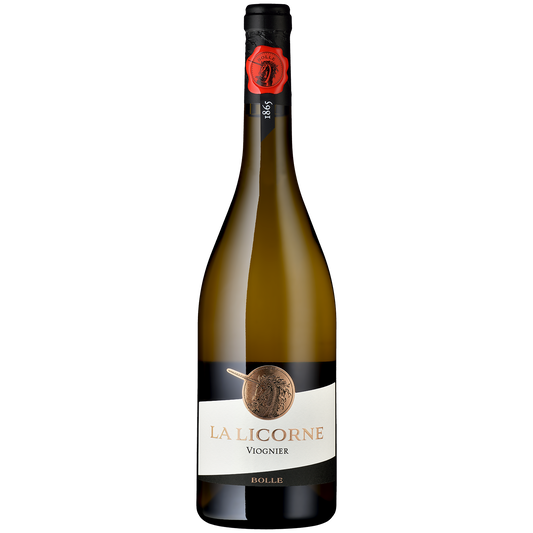
But be careful, the balance of a wine is not limited to its acidity, which we hear too often. The texture, of the grape variety and that provided by aging in wood (like here Cure d'Attalens, Viognier or here La Licorne Viognier ) or in "amphora" - sandstone or concrete vats, which breathe (like here Cure d'Attalens, Viognier or here Prestige Viognier d'Aigle ) - can bring a lot of interest to a wine, where other grape varieties could rely solely on the backbone of acidity.
What does it go with?
Viognier is a wine for meals rather than an aperitif. And the good news is, it pairs well with a wide variety of dishes, from starters to desserts!
Some suggestions:
- White asparagus, steamed or grilled, with hollandaise sauce
- Salads with exotic fruits and nuts
- River, lake, or deep-sea fish (a salmon fillet will work perfectly!)
- Goat cheeses
- Apricot cake